Why Gas Detection in Boiler Rooms Matters Most When the Heat Comes Back On
As the weather turns, boiler houses across the Northern Hemisphere are firing up for the first time in months. That's also when a class of risk most facility managers don't think about until something goes wrong starts to climb: gas.
The boiler room is one of the few places in a building where a large volume of fuel and an ignition source sit a few metres apart, day in, day out. Put a commercial kitchen on top — open flames, gas lines under constant use — and you have two of the highest-probability gas hazard zones in any non-industrial building.
Two failures, two different dangers
The first is a natural gas or LPG leak. A joint works loose, a flexible connector ages, a valve doesn't fully close after the summer shutdown. Methane has no smell of its own, which is why odorant is added — but odorant fades, and in a boiler room with forced ventilation the smell may never reach a person before the concentration does. By the time someone notices, you're already in explosion range.
The second is carbon monoxide from incomplete combustion. This one is quieter. A poorly tuned burner, a restricted flue, or a blocked air intake doesn't announce itself. CO is colourless, odourless, and it displaces oxygen without warning. In an occupied building it's the danger people wake up to too late; in an unmanned boiler room it can disable the person who walks in to investigate.
Why "check it monthly" isn't enough
A lot of buildings still treat gas safety as a scheduled inspection — a technician with a handheld detector once a quarter. That leaves the other 89 days uncovered. A leak at 2 a.m. on a Sunday doesn't wait for the calendar.
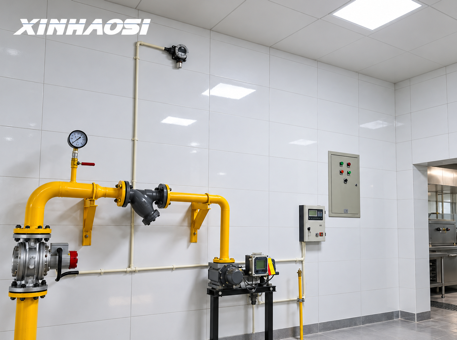
Fixed gas detection exists for exactly this. A detector mounted where the gas would actually go — near the burner, at floor level for methane, at breathing height for CO — watches continuously. When it sees a threshold, it doesn't just sound a local alarm. Through a gas alarm control panel it can drive a linkage that closes an emergency shut-off solenoid valve and cuts the fuel at the source, and alert the people who need to know, wherever they are.
That automatic chain — detect, alarm, shut the valve — is the difference between an incident and a catastrophe. A portable meter can tell you a room is dangerous. Fixed detection stops the room from becoming dangerous in the first place.
What a sensible boiler-room setup looks like
For most small-to-mid boiler rooms and commercial kitchens, the practical layout is straightforward:
- One or more fixed gas detectors covering the combustible gas (methane/LPG) and CO, placed at the points where each would actually accumulate.
- A gas alarm control panel that reads them and manages the response.
- An emergency shut-off solenoid valve on the fuel line, wired so the panel can close it on alarm.
- A clear alarm point where staff actually are — not just inside the boiler room nobody visits.
The details are what decide whether it works at 3 a.m. or just looks like it works on the installer's checklist: detector placement, the trip thresholds, whether the valve fails safe and closes on loss of power, cable routing in a hot, damp environment.
What we build for this
This is exactly what our fixed commercial and industrial gas detectors are built for. We supply these detectors together with gas alarm control panels and explosion-proof emergency shut-off solenoid valves. Having detection and shut-off hardware from a single vendor means you work with one team that fully understands both parts of the safety chain.
We're not a trading company reselling someone else's panels. The detectors, the boards and the valve bodies are built in our own workshops, which is why we can talk seriously about placement, linkage and fail-safe behaviour instead of just quoting a catalogue number.
If you're specifying or reviewing gas safety for a boiler room, a commercial kitchen, or any building with a central heating plant, we're happy to talk through the layout — not just sell the hardware.